The Bottom Line, Up Front
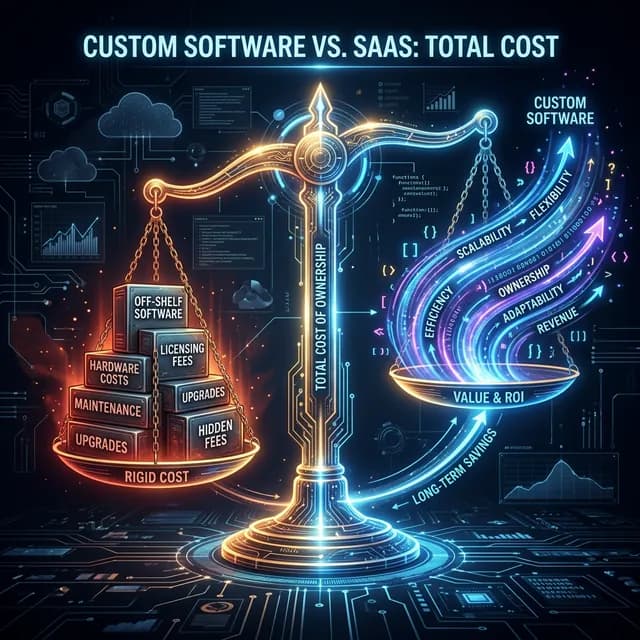
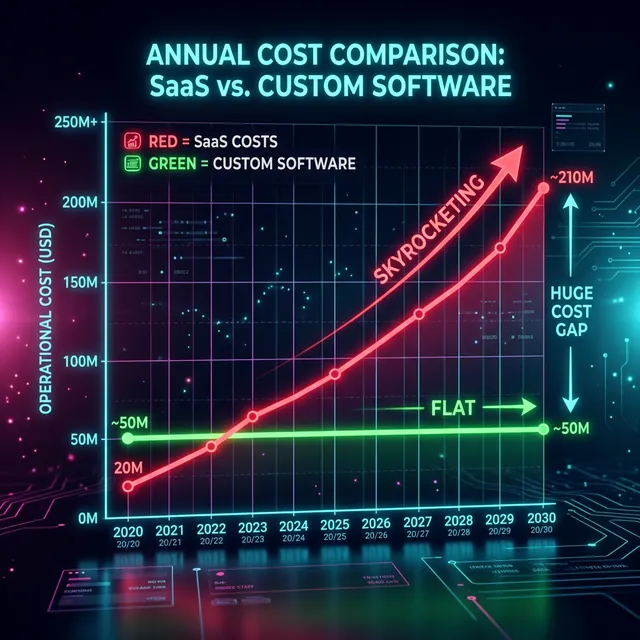
For most mid-size businesses, custom software costs $8,000 to $50,000 upfront but saves $24,000 to $180,000 or more over 3 years compared to equivalent SaaS subscriptions. The reason is straightforward: SaaS charges you every month forever, and those costs compound as you add users, features, and integrations. Custom software has a one-time build cost, plus modest hosting and maintenance, and the total flattens over time.
This is not an argument that custom software is always better. SaaS wins in many scenarios. But most businesses have never seen an honest side-by-side comparison, so they default to SaaS without realizing the long-term cost implications.
Year-by-Year Cost Breakdown
Here is a realistic comparison for a mid-size business (25 to 100 employees) replacing a workflow currently handled by a SaaS tool.
SaaS Costs Over 3 Years
| Cost Category | Monthly | Year 1 | Year 2 | Year 3 | 3-Year Total | |---|---|---|---|---|---| | Base subscription (50 seats at $50/user) | $2,500 | $30,000 | $30,000 | $30,000 | $90,000 | | Annual price increase (8-12%) | - | - | $2,400 | $5,088 | $7,488 | | Premium features / tier upgrades | $500 | $6,000 | $6,000 | $6,000 | $18,000 | | Integration / API costs | $300 | $3,600 | $3,600 | $3,600 | $10,800 | | Additional storage / usage fees | $200 | $2,400 | $2,400 | $2,400 | $7,200 | | Total | | $42,000 | $44,400 | $47,088 | $133,488 |

Custom Software Costs Over 3 Years
| Cost Category | Year 1 | Year 2 | Year 3 | 3-Year Total | |---|---|---|---|---| | Development (one-time) | $35,000 | - | - | $35,000 | | Cloud hosting (VPS / serverless) | $1,200 | $1,200 | $1,200 | $3,600 | | Maintenance and updates | $3,000 | $3,000 | $3,000 | $9,000 | | Total | $39,200 | $4,200 | $4,200 | $47,600 |
3-year savings with custom: $85,888. The break-even point in this scenario is approximately 12 months. After that, you are saving $3,000 or more every month.
The Hidden Costs of SaaS
The subscription price on the pricing page is rarely what you actually pay. These costs are often invisible until you are already locked in:
Per-seat pricing scales against you. When your team grows from 50 to 80 people, your SaaS bill jumps 60%. Custom software handles 50 or 500 users at the same hosting cost.
API rate limits force tier upgrades. Many SaaS tools cap API calls at lower tiers. Once your integrations hit the limit, you either upgrade or rebuild your workflows.
Data export fees punish leaving. Some platforms charge for bulk data exports or provide data in proprietary formats that require additional transformation work. Switching costs can reach $10,000 to $25,000 in engineering time alone.
Integration costs are ongoing. Connecting SaaS Tool A to SaaS Tool B often requires a third tool (Zapier, Make, custom middleware), each with its own subscription and maintenance burden.
Price increases are annual and compounding. The average B2B SaaS product increases pricing by 8 to 12% annually. Over 3 years, a $2,500/month subscription can become $3,100/month or higher without any additional features.
The Real Advantages of Custom Software
Beyond cost savings, custom software provides structural advantages that SaaS cannot match:
- Exact workflow match. The software does precisely what your process requires, with no workarounds, no unused features, and no forcing your team to adapt to someone else's design decisions.
- Full data ownership. Your data lives in your database, under your control. No vendor lock-in, no dependency on a third party's uptime or data policies.
- No recurring license fees. After the build, your costs are limited to hosting ($50 to $200/month for most business tools) and occasional maintenance.
- Competitive differentiation. Your custom tools become a business advantage that competitors cannot replicate by buying the same SaaS subscription.

The Real Risks of Custom Software
An honest comparison must include the downsides:
- Upfront capital requirement. You pay $8,000 to $50,000 before seeing results, compared to SaaS where you start at $500/month and scale up.
- Maintenance responsibility. You own the system, which means you own the bugs, security patches, and infrastructure updates. Budget 10 to 15% of the build cost annually for ongoing maintenance.
- Longer initial timeline. Even with AI-powered development, custom software takes 1 to 8 weeks to build. SaaS is available immediately.
- Feature development is your responsibility. SaaS vendors ship new features regularly. With custom software, every enhancement requires planning and development time.
Decision Framework: When Each Option Wins
SaaS is the better choice when:
- Your needs match an existing product with minimal customization (less than 20% of features need changing).
- Your team size is small (under 15 users) and unlikely to grow significantly.
- The problem domain changes rapidly and you benefit from the vendor's ongoing R&D investment.
- You need the tool immediately and cannot wait for a build cycle.
- The tool is not core to your competitive advantage (email, calendar, basic CRM).

Custom software is the better choice when:
- You have 25 or more users paying per-seat SaaS fees.
- Your workflow requires significant customization that SaaS cannot accommodate.
- You are integrating multiple data sources that SaaS tools handle poorly.
- Data ownership, security, or regulatory compliance is a primary concern.
- The tool is central to your operations and directly affects revenue or efficiency.
- You are currently paying $2,000 or more per month in combined SaaS subscriptions for a single workflow.
The AI Factor: Why Custom Is More Accessible Than Ever
The traditional objection to custom software has always been cost and timeline. Building something from scratch used to require $100,000 or more and 6 or more months of development time.
AI-powered development has changed this equation fundamentally. At FastDX, we use Agentic AI and Vibe Coding methods to build custom business tools in 3 to 7 days for simple applications and 1 to 3 weeks for full business platforms. Development costs start at $5,000 for focused tools and $15,000 to $50,000 for comprehensive platforms.
This means the break-even point has shifted. Where custom software once needed 2 to 3 years to recoup the investment, AI-powered builds break even in 3 to 12 months for most mid-size businesses. The math has changed, and it now favors building over renting for a much wider range of use cases.