The Framing SaaS Vendors Use
"Why build when you can subscribe?"
It sounds reasonable. A $200/month CRM versus a $40,000 custom build, the subscription pays for itself for years before you break even on the custom option.
That framing has two problems. It cherry-picks the comparison point (day one cost vs. month one cost), and it ignores how SaaS pricing actually scales when your business grows.
How SaaS Pricing Really Works
Most SaaS products are priced by seat, by usage, or by tier, and sometimes all three. The entry price you see on the website is almost never what you actually pay once you're running the software for real.
Here's a pattern we see constantly:
Year 1: You sign up at $200/month. It covers 5 users. The tool solves the immediate problem and the team is happy.
Year 2: You've grown to 12 users. You need to upgrade to the Business tier at $600/month. You also need the reporting add-on ($80/month) and the API integration module ($120/month). You're now at $800/month.

Year 3: The vendor raises prices. The tier you're on increases by 20%. You're at $960/month and the features you actually use haven't changed.
Over 3 years, you've paid $200 + $800 + $960 = approximately $24,000, and climbing.
The Custom Build Maths
A purpose-built internal tool that covers the same scope as that SaaS product typically costs $8,000–$25,000 to build, depending on complexity. Let's use $15,000 as a representative midpoint.
| | SaaS (3 years) | Custom (3 years) | |---|---|---| | Year 1 | $2,400 | $15,000 (build) | | Year 2 | $9,600 | $300 (hosting) | | Year 3 | $11,520 | $300 (hosting) | | Total | $23,520 | $15,600 |
The custom build costs less by year two. And from year three onward, the SaaS product is the expensive option.
What the Numbers Don't Capture
The cost comparison above only looks at direct spend. It doesn't account for:

Fit cost. Generic software forces process changes. Your team learns to work around limitations, creates supplementary spreadsheets, and develops workarounds that add friction. This is invisible cost, but it's real.
Data portability. SaaS products hold your data. If you leave, export options are often limited. Migrating is painful. Custom software stores data in your own database, in your own format.
Feature bloat. You pay for every feature in the SaaS product, including the 70% your team will never use. Custom software contains exactly what you need and nothing else.
Vendor risk. SaaS products get acquired, pivot, raise prices dramatically, or shut down. We've seen clients scrambling to replace tools that were discontinued with 90 days notice.
The 5-Year Total Cost of Ownership
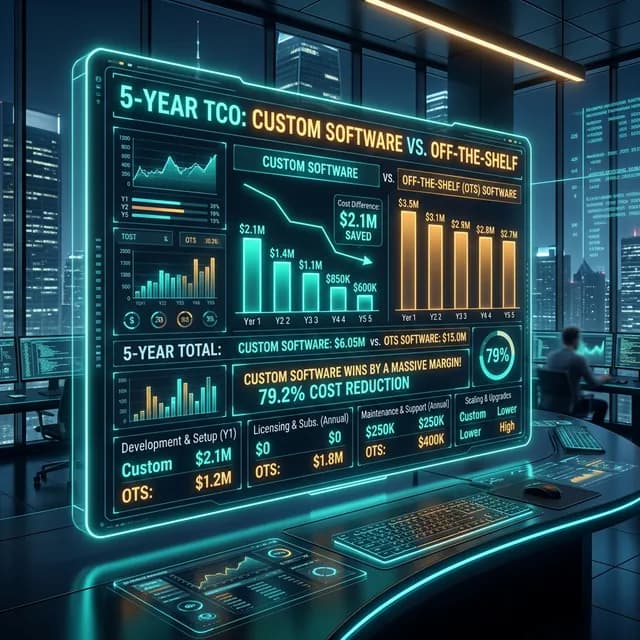
Most comparisons stop at 3 years. Here's what the full picture looks like over 5 years with realistic SaaS price escalation:
| Year | SaaS Cost (8% annual increase) | Custom Software Cost | SaaS Cumulative | Custom Cumulative | |---|---|---|---|---| | Year 1 | $9,600 | $15,000 (build) + $300 | $9,600 | $15,300 | | Year 2 | $10,368 | $300 (hosting) | $19,968 | $15,600 | | Year 3 | $11,197 | $300 + $2,000 (updates) | $31,165 | $17,900 | | Year 4 | $12,093 | $300 | $43,258 | $18,200 | | Year 5 | $13,060 | $300 + $2,000 (updates) | $56,318 | $20,500 |

5-year savings with custom: $35,818. By year 5, you are paying $13,060/year in SaaS versus $300–$2,300/year for custom, a 5–43x difference in annual operating cost.
When SaaS Still Makes Sense
This isn't an argument against SaaS as a category. Some tools genuinely belong in the subscription model:
- Commodity tools (email, document storage, video calls), no business logic, no competitive advantage, perfect candidates for SaaS
- Regulated domains (payroll, legal compliance), specialised tools with ongoing compliance updates that would be expensive to maintain yourself
- Team size under 3, before you have enough data to know what you actually need
The decision isn't "SaaS is bad." It's "SaaS is the wrong choice for this specific workflow that's core to how your business runs."
Running the Calculation for Your Business
Before your next SaaS renewal, do this:
- List every SaaS subscription your team actively uses
- Note the monthly cost and number of users for each
- Identify which ones you've built workarounds for (supplementary spreadsheets, copy-paste between systems, manual steps that "should be automatic")
- For those tools: multiply the monthly cost by 36 (3-year total)
- Compare that number to a one-time build cost

If the 3-year SaaS spend exceeds $10,000 for a single workflow, a custom build is almost always worth evaluating.
Most businesses run this exercise and find two or three tools that cross that threshold immediately.
Quick Reference: Build Cost by Tool Type
| Business Tool | SaaS Cost/Year (25 users) | Custom Build Cost | Annual Hosting | Break-Even | |---|---|---|---|---| | CRM | $15,000–$45,000 | $10,000–$25,000 | $600–$1,800 | 4–12 months | | Project management | $6,000–$15,000 | $5,000–$15,000 | $600–$1,200 | 6–18 months | | Inventory system | $8,000–$24,000 | $8,000–$18,000 | $600–$1,200 | 5–14 months | | Reporting dashboard | $12,000–$36,000 | $6,000–$15,000 | $600–$1,200 | 3–8 months | | Help desk / ticketing | $9,000–$24,000 | $8,000–$20,000 | $600–$1,200 | 5–14 months |
The AI-powered development factor changes the equation further: build costs listed above reflect AI-assisted timelines that are 60–80% lower than traditional custom development quotes.