The SaaS Honeymoon Phase
When you're starting out, SaaS tools are a lifesaver. Sign up, pay monthly, get a feature-rich product in minutes. No servers to manage, no developers to hire.
But something changes as businesses grow. The tool that once felt like a perfect fit starts to show its edges.
5 Signs You've Outgrown Your SaaS Stack
1. You're paying for seats you don't use, but can't downgrade
Enterprise tiers bundle features you need with minimums you don't. You need 12 seats but the plan starts at 25. That's dead money every month.
2. You've built workarounds on top of workarounds
Your team uses a combination of the tool + Zapier + a spreadsheet to approximate the workflow you actually need. Every new hire has to learn a system that doesn't make sense.

3. Data lives in too many places
Your CRM has client history. Your accounting software has invoices. Your project tool has task data. None of them talk to each other without an integration that breaks every few months.
4. Your monthly SaaS bill rivals a developer's salary
Add up Salesforce, HubSpot, Asana, Zendesk, QuickBooks, Slack. For a 30-person company, $15,000/month in SaaS isn't unusual. That's $180,000 a year, enough to build and own several custom tools.
Here's a real breakdown for a 30-person company:
| Tool | Per Seat/Month | 30 Users/Month | Annual | |---|---|---|---| | Salesforce (Enterprise) | $165 | $4,950 | $59,400 | | HubSpot (Professional) | $45 | $1,350 | $16,200 | | Asana (Business) | $25 | $750 | $9,000 | | Zendesk (Professional) | $55 | $1,650 | $19,800 | | Slack (Business+) | $13 | $390 | $4,680 | | QuickBooks (Advanced) | flat | $200 | $2,400 | | Zapier (integrations) | flat | $250 | $3,000 | | Total | | $9,540 | $114,480 |

With AI-powered development, you could replace the 2–3 most expensive tools with custom alternatives for $20,000–$50,000 in one-time build cost, saving $50,000–$80,000 per year from year two onward.
5. The vendor roadmap doesn't match your roadmap
You need a feature. You've requested it. It's been "planned" for 18 months. Meanwhile you're adapting your process to the software instead of the other way around.
What Custom Software Actually Costs
The sticker shock of custom software, "$50,000 to build a CRM?", misses the comparison point. That's a one-time cost against $15,000/year (or more) in SaaS subscriptions, forever.
AI-assisted development has also changed the math dramatically:
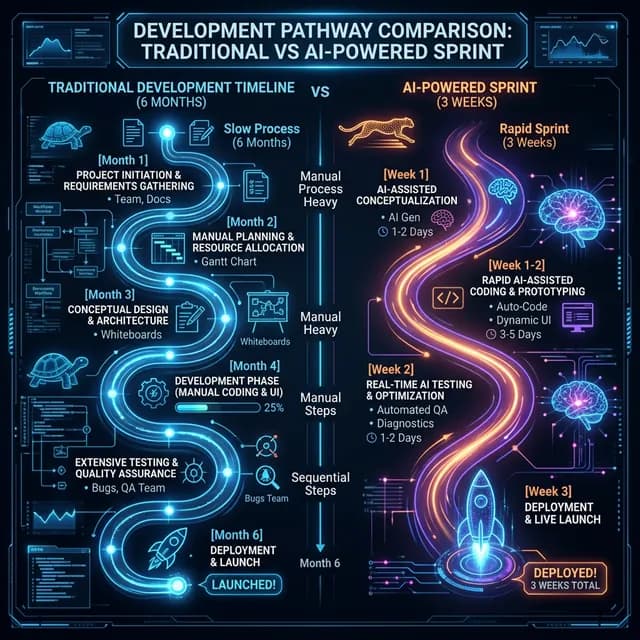
| Factor | Traditional Custom Dev | AI-Powered Custom Dev | |---|---|---| | Timeline | 4–8 months | 1–4 weeks | | Team size | 3–5 developers | 1 senior engineer + AI | | Cost | $75,000–$250,000 | $5,000–$50,000 | | Break-even vs SaaS | 18–36 months | 3–8 months | | Maintenance cost | 15–20% of build/year | 10–15% of build/year |

The break-even point has moved dramatically. A custom CRM that used to cost $120,000 and take 6 months can now be built for $15,000–$25,000 in 2–3 weeks.
The Right Time to Make the Switch
Not every business needs custom software. The right moment is when:
- Your SaaS costs exceed what custom development would cost over 2–3 years
- You're losing competitive advantage because competitors have tools built for their process
- Your team is spending more time managing integrations than doing actual work
The goal isn't to replace every SaaS tool. It's to identify the 1–2 core systems where a custom solution would give you an unfair advantage, and build those.
Next Steps
Start with a cost audit. List every SaaS tool, its monthly cost, and how many people actively use it. Then ask: what would this workflow look like if we built it exactly for our business?
That question is usually the start of something better.