The Challenge
A private hospital group with 3 locations and 50,000+ patients had zero digital patient engagement. Every interaction required a phone call or in-person visit:
- Appointment booking – Patients called a hotline that was busy 40% of the time
- Lab results – Patients had to visit the clinic to pick up paper printouts
- Billing – Invoices mailed by post; payment by bank transfer or in-person
- Medical records – Paper files stored in physical archives
- Prescription refills – Required a phone call and 24-48 hour turnaround
The hospital had evaluated off-the-shelf patient portal solutions. The quotes ranged from $80,000-$150,000 with 4-6 month implementation timelines and ongoing per-patient licensing fees.
The urgency:
A competitor hospital had just launched their own patient portal. Every week without a digital solution meant patients switching providers for convenience.

The Solution
FastDX built a complete patient portal in 2 weeks using AI-accelerated vibe coding.
Core features delivered:
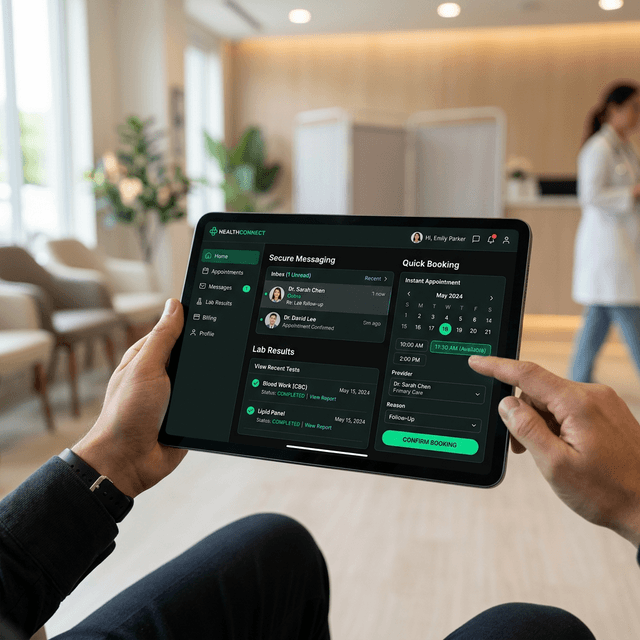
- Online Booking – Browse available slots by doctor, specialty, or location; book and reschedule instantly
- Lab Results – Secure access to test results with doctor's notes and reference ranges
- Secure Messaging – HIPAA-aligned encrypted messaging between patients and care teams
- Billing Dashboard – View invoices, payment history, and pay online
- Prescription Management – Request refills with one click; track pharmacy status
- Family Profiles – Parents manage children's and elderly family members' health records
- Push Notifications – Appointment reminders, result availability, and billing alerts
Technical highlights:
- Stack: Next.js App Router, Supabase with Row-Level Security (patient data isolation)
- Auth: Multi-factor authentication with SMS verification
- Compliance: End-to-end encryption, audit logging, data residency controls
- Integrations: Connected to hospital's existing HIS (Hospital Information System) via HL7 FHIR
- Performance: Sub-2-second page loads even on 3G mobile networks
- Accessibility: WCAG 2.1 AA compliant
How AI accelerated delivery:
| Phase | Traditional | With AI | |-------|------------|---------| | Requirements analysis | 2 weeks | 2 days | | UI/UX design | 3 weeks | 4 days | | Backend development | 6 weeks | 5 days | | Integration & testing | 3 weeks | 3 days | | Total | 14 weeks | 2 weeks |
The Results
After the first month of operation:
- 78% patient adoption – 39,000 of 50,000 patients created accounts
- 60% reduction in phone calls – Front desk staff redirected to in-person patient care
- 4.8/5 app rating – Patient satisfaction survey across all 3 locations
- NPS score of +72 – Up from +31 before the portal launch
- 12-minute average session – Patients actively engaging with their health data
- $0 per-patient cost – No ongoing licensing fees (vs. $2-5/patient/month for SaaS solutions)

The Impact on Operations
| Metric | Before | After | Impact | |---|---|---|---| | Patient NPS | +31 | +72 | 132% improvement | | Phone call volume | 100% of inquiries | 40% (60% reduction) | 3 FTEs redirected to care | | No-show rate | High | 35% reduction | Automated reminders + easy reschedule | | Billing cycle (avg payment) | 45 days | 12 days | 73% faster collections | | Prescription refill turnaround | 24-48 hours | Instant (one-click) | Same-day processing | | Patient portal adoption | 0% (no portal) | 78% (39,000 patients) | First month | | Per-patient software cost | $2-5/month (SaaS quotes) | $0 (owned) | $1.2M-$3M/year saved at scale | | Project investment | $80,000-$150,000 (competitor quotes) | ~$25,000 | 70-83% less | | Payback period | – | ~2 months | From phone staff reallocation alone |

Client Feedback
"Our competitors took 6 months to launch a basic portal. We launched a better one in 2 weeks. Patients tell us it's the reason they switched to our hospital."
– Chief Digital Officer
Key Takeaway
Healthcare digital transformation doesn't require enterprise timelines or enterprise budgets. AI-assisted development can deliver compliant, secure, and patient-friendly portals in weeks – giving smaller hospital groups the digital capabilities that were previously only available to large health systems.