The Challenge
A manufacturing company with 150 employees was drowning in software subscriptions. Their tech stack included separate tools for inventory management, order tracking, HR, accounting, project management, customer communication, reporting, and quality control.
Each tool had its own login, its own data format, and its own way of doing things. Getting a complete picture of operations required exporting data from 5 different systems and manually combining spreadsheets – a process that took their operations manager 8+ hours every week.
Monthly SaaS spend: $8,000 Data sources: 8 disconnected systems Time wasted on manual reporting: 32+ hours/month
The Solution
FastDX designed and built a unified operations platform that consolidated the core functionality from all 8 tools into a single system.
What we built:
- Inventory Management – Real-time stock tracking with automated reorder alerts
- Order Pipeline – From quote to delivery with status tracking at every stage
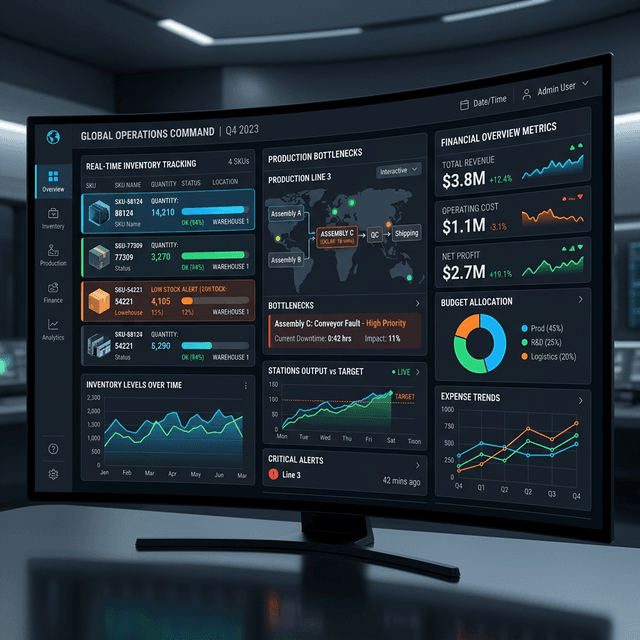
- Production Dashboard – Live view of production lines, capacity, and bottlenecks
- Quality Control – Inspection checklists, defect tracking, and compliance reporting
- HR Module – Employee records, attendance, and leave management
- Financial Overview – Revenue, costs, and profitability by product line
- Customer Portal – Clients can check order status and download invoices
- Unified Reporting – One dashboard for everything. No more spreadsheet gymnastics.

Technical approach:
- Stack: Next.js, Supabase (PostgreSQL), deployed on Vercel
- Methodology: vibe coding – architecture-first, AI-assisted implementation
- Timeline: 6 weeks from system design to full production deployment
- Team: 1 senior engineer with AI acceleration
Phased delivery:
- Weeks 1-2: Requirements gathering, system design, data migration planning
- Weeks 3-4: Core module development (inventory, orders, production, finance)
- Weeks 5-6: Integration testing, data migration, staff training, go-live
The Results
After 3 months of using the new platform:
| Metric | Before (8 SaaS Tools) | After (Unified Platform) | Impact | | ---------------------------- | --------------------------- | --------------------------- | ---------------------------------- | | Monthly software cost | $8,000 | $2,400 | 70% reduction ($5,600/month saved) | | Annual software savings | – | $67,200/year | vs. previous SaaS spend | | Manual reporting hours | 32+ hours/month | 0 (automated) | 384 hours/year recovered | | Data export/reconciliation | 8+ hours/week | Real-time unified dashboard | Eliminated entirely | | Systems requiring login | 8 separate tools | 1 platform | Single source of truth | | Production defect tracking | Manual spreadsheet | Automated with alerts | 23% fewer missed defects | | Order-to-delivery visibility | Fragmented across 3 tools | End-to-end in one view | Real-time status tracking | | Data ownership | Vendor-locked (8 providers) | 100% owned | Zero lock-in risk | | Project investment | – | $28,000 | Payback in 5 months | | Scalability | Limited by SaaS tier caps | 3x current volume | No per-seat pricing |
Client Feedback
"We went from checking 8 different apps every morning to opening one dashboard that shows everything. The time savings alone paid for the project in the first month."
– Operations Director
Key Takeaway
The total investment in custom software was less than 4 months of their previous SaaS spend. The platform now handles their entire operation, they own every line of code, and their monthly software cost dropped from $8,000 to $2,400 (hosting and maintenance only).