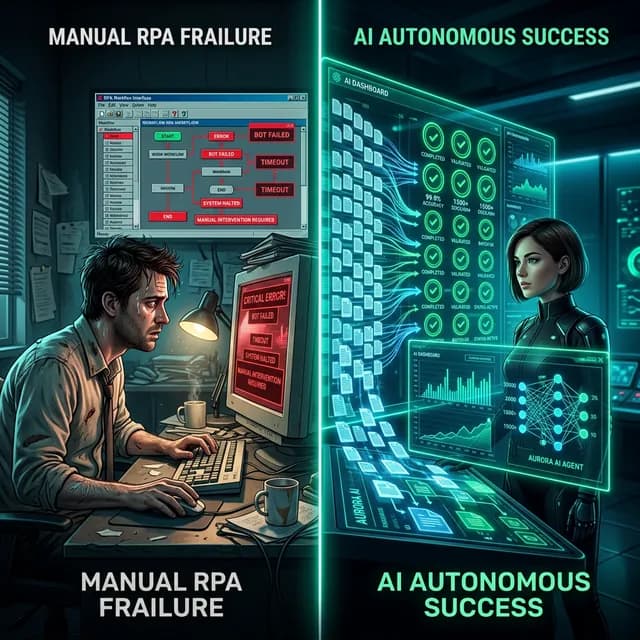
Three Technologies, One Promise: Less Manual Work
Your finance team manually keys in data from supplier invoices. Your operations team copy-pastes order details between systems. Your CS team reads emails and updates CRM records by hand.
Every vendor selling automation says they can fix this. RPA vendors, workflow automation platforms, and Agentic AI companies all say the same thing: automate your manual processes.
But they solve different problems, handle different levels of complexity, and have dramatically different total costs. Here's how to choose.
What Each Technology Actually Does
Robotic Process Automation (RPA)
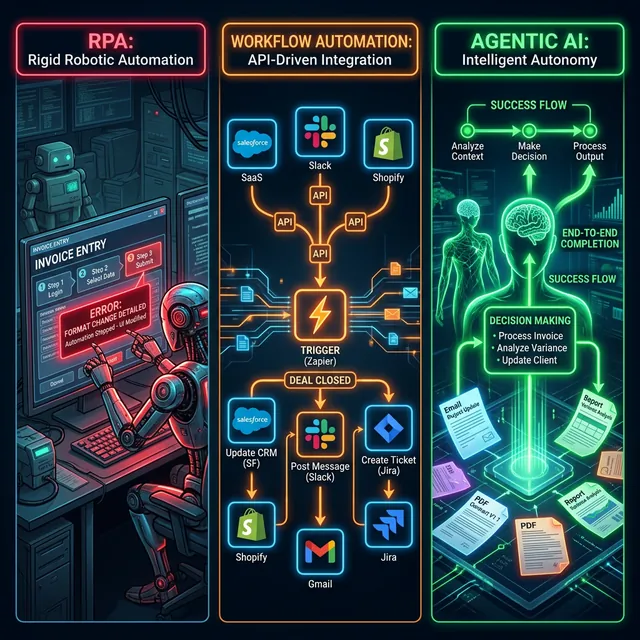
RPA uses software robots that mimic what a human does on a computer: clicking, typing, reading screen text, copying between applications.
How it works: You record a sequence of exact actions. The robot replays them.
Best for: Structured, repetitive tasks on stable interfaces - like copying data from a fixed-format spreadsheet into a specific field in a legacy system that has no API.
Key limitation: Zero tolerance for variation. If the spreadsheet column moves, the robot fails. If the system UI updates, the robot fails. RPA is brittle by design because it operates at the pixel level.
Workflow Automation (Zapier, Make, n8n)
Workflow tools connect applications via APIs and trigger actions based on events.
How it works: When this happens in App A → do this in App B. It's logic-based, not AI-based.
Best for: Connecting modern SaaS apps that have clean APIs and produce structured, predictable data. Moving a Typeform submission into a CRM and sending a Slack notification.
Key limitation: Works only with structured data in a predefined format. Cannot handle email content, PDFs, voice, images, or any unstructured input. Cannot make decisions - only follows fixed rules.
Agentic AI
Agentic AI uses large language models combined with tool-use capabilities to pursue a goal across multiple steps, handling variation and making decisions along the way.
How it works: You define a goal. The agent plans, uses tools (APIs, databases, browsers, code execution), checks its work, and completes the goal - adapting to whatever inputs arrive.
Best for: Complex, multi-step processes that involve unstructured inputs (emails, documents, images), require judgment for ambiguous cases, or vary significantly from instance to instance.
Key limitation: Higher implementation complexity and cost than simple automation. Not appropriate for truly trivial single-step tasks.
Side-by-Side Comparison
| Dimension | RPA | Workflow Automation | Agentic AI | | ----------------------- | ------------------------ | ---------------------- | ------------------------------ | | Input types | Structured, fixed format | Structured API data | Any - text, PDF, email, images | | Decision-making | None - exact rules only | None - fixed logic | Yes - understands context | | Handles variation | ❌ Breaks on change | ❌ Fails outside rules | ✅ Adapts to variation | | Multi-step | Yes (fixed sequence) | Yes (fixed sequence) | Yes (dynamic sequence) | | Implementation cost | Medium | Low–Medium | Medium–High | | Maintenance cost | High (brittle) | Low | Low–Medium | | Accuracy | 100% on known inputs | 100% on known inputs | 93–99% on variable inputs | | Best ROI scenario | Legacy system, no API | Clean SaaS data | Complex document workflows |
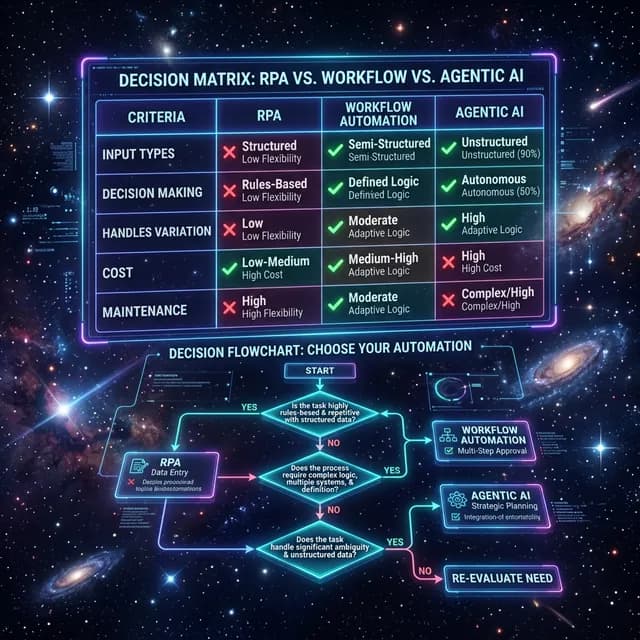
The Decision Framework
Use this to choose:
Use RPA when:
- You need to interact with a legacy system that has no API and no way to add one
- The process is completely fixed: same inputs, same format, same sequence, every time
- You need a quick win in the next 2–4 weeks with low budget
- You can accept ongoing maintenance cost when UIs change
Use Workflow Automation when:
- All your apps have clean APIs and produce structured data
- The trigger and response are simple: one event causes one action
- You're connecting SaaS tools, not processing documents or emails
- Volume is low to medium and errors are easily caught
Use Agentic AI when:
- Inputs are variable - emails, PDFs, images, free text, customer messages
- The process requires judgment for ambiguous cases
- Multiple steps and multiple systems are involved
- You're processing at high volume (hundreds or thousands per day)
- Manual labour cost on the process is significant ($50K+/year)
- You want the system to improve in accuracy over time
Real Scenario: Invoice Processing
With RPA: The robot reads invoices in a specific PDF template from a specific supplier. Works perfectly - until the supplier changes their PDF layout. Then someone manually fixes the robot. Repeat every few months.
With Workflow automation: Only works if suppliers submit via a structured API or form. Doesn't handle email attachments, scanned documents, or variation in field names.
With Agentic AI: Agent receives invoices by email in any format - PDF, image, Word document, structured XML. Extracts fields, validates against PO, routes for approval if over threshold, posts to ERP. Handles 15 different supplier formats with one system. Gets more accurate over time as it processes more examples.
Common Mistakes
Mistake 1: Using RPA for everything Companies that standardised on RPA five years ago are now maintaining 200 fragile bots. Every system update breaks something. Their automation team spends 60% of their time on maintenance.
Mistake 2: Expecting workflow automation to handle documents Zapier cannot read a PDF. Make cannot interpret a customer email and decide how to route it. These tools are designed for structured data - using them on unstructured inputs requires extensive pre-processing.
Mistake 3: Using Agentic AI for trivial tasks If your process is "when a form is submitted, send a Slack message" - use Zapier. The added complexity and cost of an AI agent is not justified for one-step, fully structured workflows.
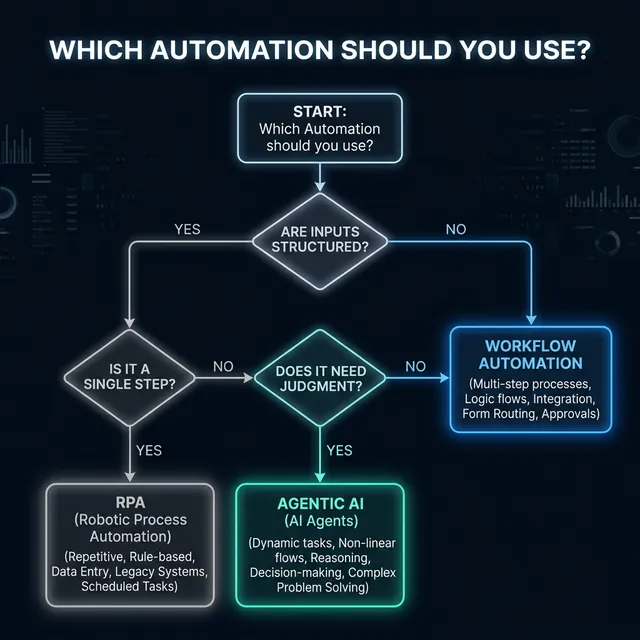
The Hybrid Approach: What Most Businesses Need
In practice, most businesses need all three in different parts of their operation:
- Workflow automation for connecting SaaS tools and simple event-driven flows
- RPA for one or two legacy systems that genuinely cannot be reached any other way
- Agentic AI for the high-volume, document-heavy, judgment-required processes
At FastDX, we typically see the biggest ROI from Agentic AI in:
- Invoice and document processing - finance teams doing 4–8 hours/day of document work
- Customer support triage - routing and resolving high-volume ticket queues
- Sales intelligence - researching accounts and updating CRM from unstructured sources
- Compliance monitoring - continuously checking transactions, contracts, or communications against rules
- Logistics and operations - processing shipping documents, customs declarations, delivery confirmations
What It Costs
| Approach | Implementation | Monthly maintenance | | ------------------- | --------------- | ----------------------- | | RPA (basic process) | $10,000–$50,000 | $2,000–$5,000 | | Workflow automation | $1,000–$10,000 | $200–$1,000 + tool cost | | Agentic AI system | $5,000–$30,000 | $500–$2,000 |
The critical difference: RPA maintenance costs compound as you add more bots and as systems change. Agentic AI maintenance is lower because the agent handles variation that would otherwise require bot updates.
A business processing 500 documents per day spending $200K/year on a manual team can typically deploy an Agentic AI system for $15,000–$25,000 and reduce the team to 1–2 exception handlers - saving $120,000–$150,000/year.
Talk to FastDX
FastDX builds Agentic AI systems for document processing, workflow automation, and business intelligence. Typical delivery: 2–4 weeks. You own the code. No recurring licence.
Get a free consultation on automating your business processes →