AI Just Levelled Up - Meet Agentic AI
Most businesses know AI as a tool that answers questions. You type, it replies. Useful, but passive.
Agentic AI is fundamentally different. Instead of waiting to be asked, an AI agent is given a goal and figures out - on its own - the sequence of steps needed to achieve it. It uses tools, makes decisions, calls APIs, reads files, writes code, and loops back to verify its own work.
The name comes from the word agency: the capacity to act independently.
The Core Difference: Reactive vs. Agentic
| | Traditional AI (LLM/Chatbot) | Agentic AI | | --------------------- | ---------------------------- | ------------------------------- | | Trigger | You send a message | You define a goal | | Steps | One response | Multi-step plan | | Tools | Text only | APIs, databases, browsers, code | | Memory | Usually stateless | Maintains context across steps | | Loops | No - responds once | Yes - checks its own output | | Human involvement | Every step | Only at exceptions |
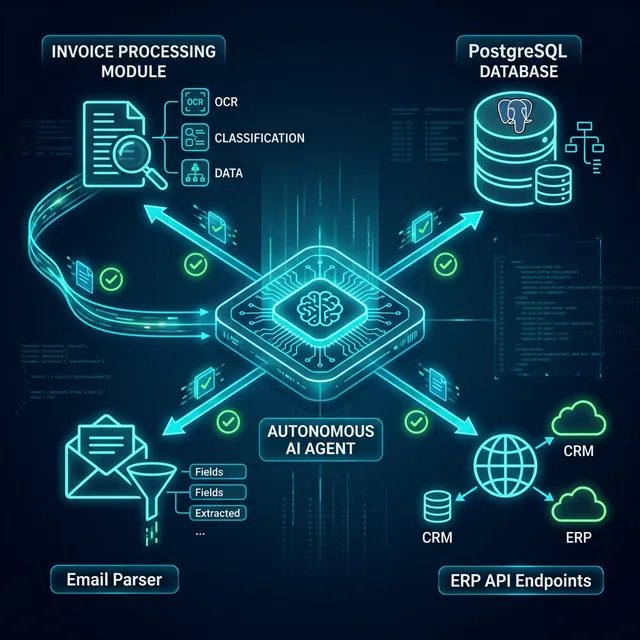
A chatbot tells you how to process an invoice. An AI agent processes the invoice - reads it, validates fields, queries your ERP, flags anomalies, and posts the entry.
How an Agentic AI System Works
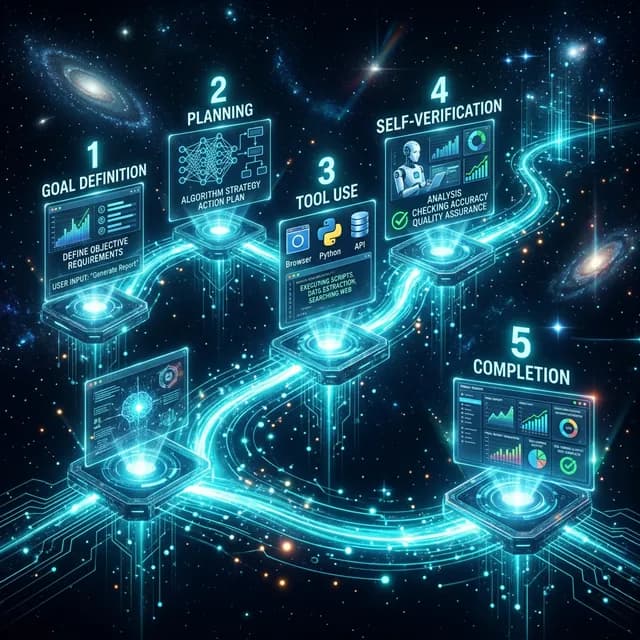
Here is the typical architecture of an agentic workflow:
1. Goal definition - You (or your system) give the agent a goal in natural language: "Process all incoming supplier invoices and post approved ones to the accounting system."
2. Planning - The agent breaks the goal into subtasks: extract data → validate → check against PO → route for approval if over threshold → post to ERP.
3. Tool use - The agent uses tools to execute each step: an OCR API to extract text, a database query to check POs, an email tool to send approval requests, an ERP API to post entries.
4. Self-verification - After each step, the agent checks its own output against expected criteria. If something is wrong, it retries or escalates.
5. Completion - The agent reports what it did, what decisions it made, and any exceptions that required human input.
Real Business Examples
Example 1: Logistics Document Processing
A freight company receives 400 delivery documents per day. Previously a team of 6 manually extracted data, checked customs codes, and updated the TMS. With an Agentic AI system:
- Documents arrive by email or upload
- Agent extracts all fields with 97% accuracy
- Cross-references HS codes against a compliance database
- Flags discrepancies for human review (5–8% of documents)
- Posts clean records to the TMS automatically
- Result: 92% of documents processed with zero human touch. Team now handles exceptions only.
Example 2: Customer Support Triage
An e-commerce business receives 800 support tickets per day. An AI agent:
- Reads each ticket
- Checks order status, return history, and customer tier via API
- Resolves 60% of tickets automatically (order status, return initiation, tracking)
- Routes remaining 40% to the right team with context pre-loaded
- Result: Average resolution time drops from 18 hours to 4 hours.
Example 3: Sales Intelligence
A B2B sales team wants daily research on target accounts. An agent:
- Checks LinkedIn, news sources, and company websites each morning
- Summarises changes relevant to the sales pitch
- Updates the CRM with new signals
- Flags accounts with buying triggers (new funding, leadership change, expansion news)
- Result: Sales team stops doing 2 hours of daily research. Conversion rate improves 23%.

Agentic AI vs. RPA vs. Traditional Automation
You might be thinking: this sounds like RPA (Robotic Process Automation) or regular workflow automation.
Here's the difference:
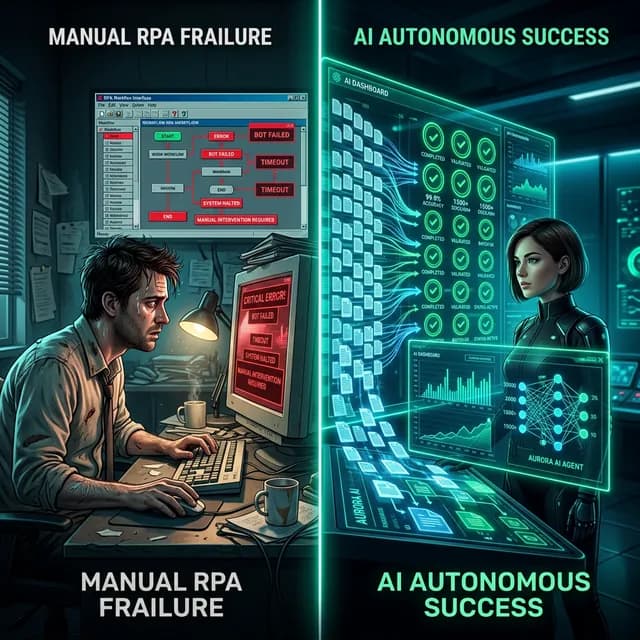
RPA follows explicit rules. If the invoice format changes, the bot breaks. It handles zero ambiguity.
Traditional automation connects known APIs in a fixed sequence. It has no ability to handle unexpected inputs.
Agentic AI understands context, handles variation, decides what tool to use, and adapts when something unexpected happens. It can process a PDF invoice, a scanned image, and a structured XML file using the same goal - because it understands intent, not just format.
When Should Your Business Use Agentic AI?
Agentic AI is the right choice when:
✅ The process involves multiple steps with decisions in between ✅ Inputs are semi-structured or variable (emails, PDFs, free text) ✅ The process currently requires skilled human judgement for routine cases ✅ Volume is high enough that manual effort is a cost problem ✅ Errors have meaningful consequences (compliance, customer experience, financials)
Agentic AI is not the right choice when:
- The process is a single step with a single API call (just use automation)
- 100% determinism is required with zero tolerance for any error
- Volume is low enough that the ROI doesn't justify development cost
How FastDX Builds Agentic AI Systems
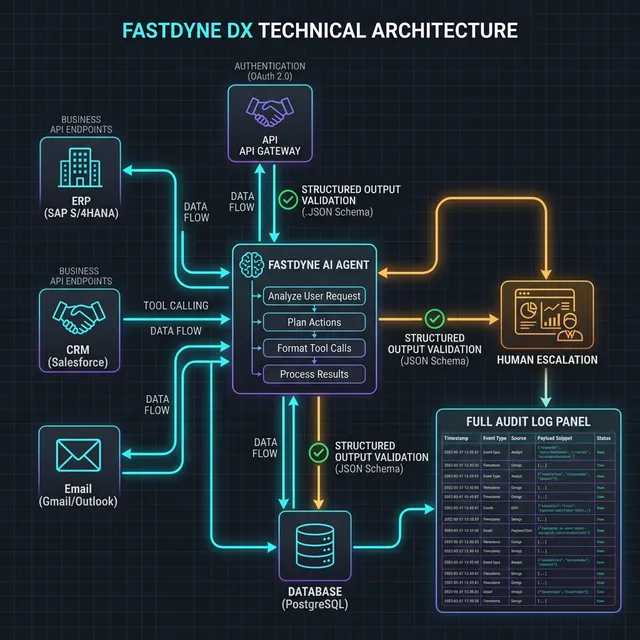
At FastDX, we build Agentic AI using a combination of:
- Large language models (OpenAI GPT-4o, Claude, or Gemini) for reasoning and decision-making
- Tool calling / function calling to connect agents to your real systems (ERP, CRM, email, databases)
- Structured output validation to ensure agent outputs meet your schema before they touch production data
- Human-in-the-loop escalation for defined edge cases
- Observability - full audit logs of every decision the agent made, every tool it called, and every output it produced
Delivery time: 1–3 weeks for a focused Agentic AI workflow. Cost: $5,000–$20,000 depending on complexity and system integrations.
The Bottom Line
Agentic AI is not science fiction and it's not a distant roadmap item. Businesses are deploying it today to automate workflows that were previously too complex for traditional automation.
The distinction to remember: chatbots talk, AI agents act.
If your team is spending hours on repetitive, multi-step tasks that require some judgment but mostly follow a pattern - that's an Agentic AI opportunity.
Talk to FastDX about building an AI agent for your business →