The Difference Between "AI-Powered" and "AI-Native"
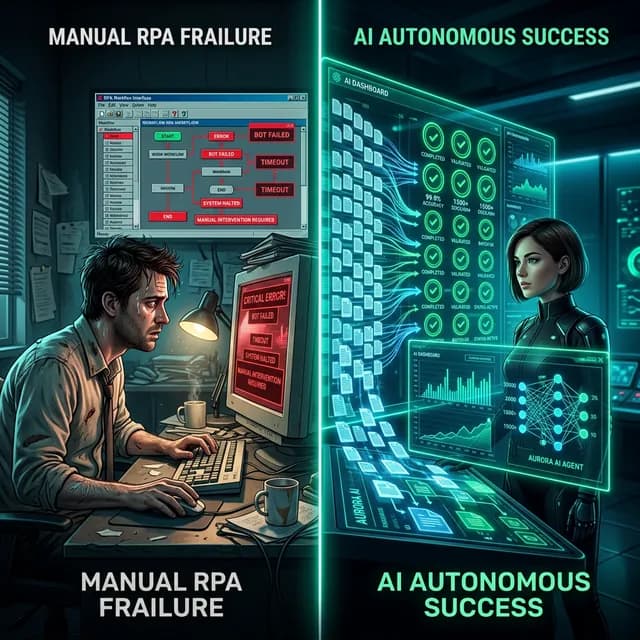
Go to any software company's website today and you'll see "AI-powered" somewhere in the header. It usually means one of two things: they added a chatbot, or they're using OpenAI's API to summarise text somewhere in the product.
That's not AI-Native software.
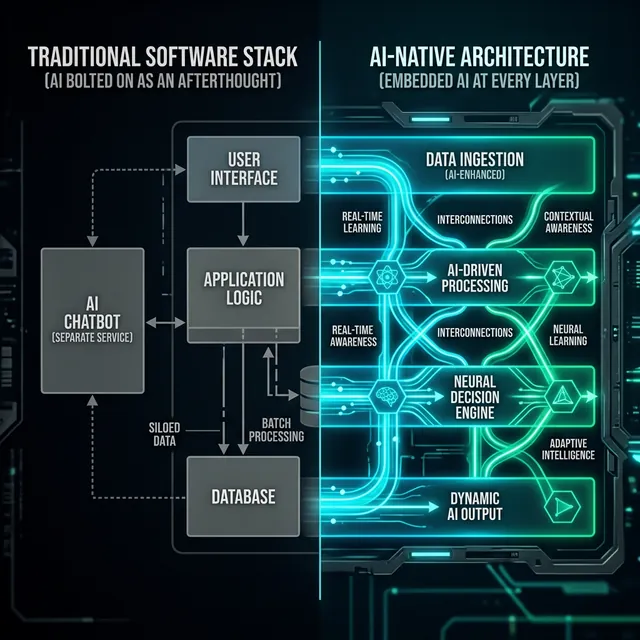
AI-Native software is software where AI is embedded in the architecture from the ground up - not bolted on as a feature, but woven into how the system is built, how it makes decisions, and how it improves over time.
The analogy: mobile-native software was built for touchscreens from day one. Responsive web design was just desktop software squeezed onto a small screen. The difference in quality was obvious.
AI-Native is the same shift, happening now.
What Makes Software Truly AI-Native?
1. AI in the Build Process
AI-Native software is often built with AI too - using approaches like Vibe Coding, where engineers describe system behaviour in natural language and AI generates and validates the implementation. This reduces development time by 5–10x and eliminates entire categories of manual coding error.
2. AI in the Data Layer
Traditional software stores data and waits for queries. AI-Native software actively processes data - extracting meaning, detecting patterns, flagging anomalies - without being asked. Your inventory system doesn't just record stock levels; it predicts shortages and suggests reorder quantities.
3. AI in the Decision Layer
Instead of rigid if/then rules, AI-Native software uses models to make decisions that handle variation and ambiguity. A non-AI-Native system rejects a form with an unexpected field value. An AI-Native system understands the intent, validates contextually, and either proceeds or flags for review.
4. AI Loops That Improve Over Time
AI-Native systems can be designed to get better with use - feeding outcomes back into models, updating classification accuracy, and refining their own rules based on real-world data.
Practical Examples
CRM That Writes Itself
A traditional CRM records what your salespeople type in. An AI-Native CRM:
- Reads email threads and automatically updates contact records
- Summarises call transcripts and logs next steps
- Scores leads based on engagement patterns across all touchpoints
- Flags deals at risk based on response time changes
The salesperson doesn't enter data. The system understands the conversation.
ERP That Catches Its Own Errors
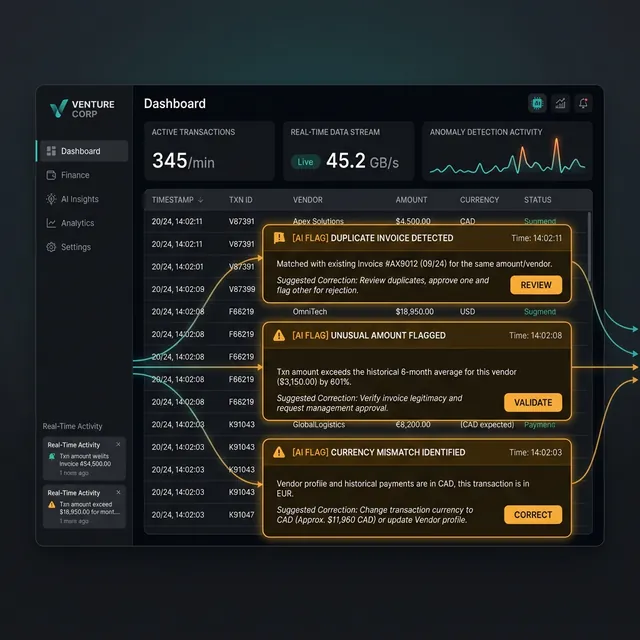
A traditional ERP posts whatever the user enters or the integration sends. An AI-Native ERP:
- Validates entries against historical patterns before posting
- Detects unusual amounts, duplicate invoices, or mismatched currency
- Flags out-of-policy transactions before they hit the ledger
- Suggests corrections rather than rejecting and requiring resubmission
Dashboard That Tells You What Matters
A traditional dashboard displays charts. An AI-Native dashboard:
- Monitors all metrics continuously in the background
- Surfaces only the anomalies and trends that require your attention
- Writes a plain-language summary of what changed and why
- Suggests actions based on the pattern it detected
Why Does This Matter for Total Cost of Ownership?
AI-Native software has a profoundly different cost structure over time.
Traditional software:
- High initial build cost
- High ongoing maintenance as business rules multiply
- Requires constant customisation as business changes
- Staff costs grow proportionally with volume
AI-Native software:
- Comparable or lower initial build cost (if using Vibe Coding)
- Lower maintenance - AI handles edge cases that would require rule changes
- Adapts to new inputs without code changes in many cases
- Staff costs decouple from volume - agents handle routine cases
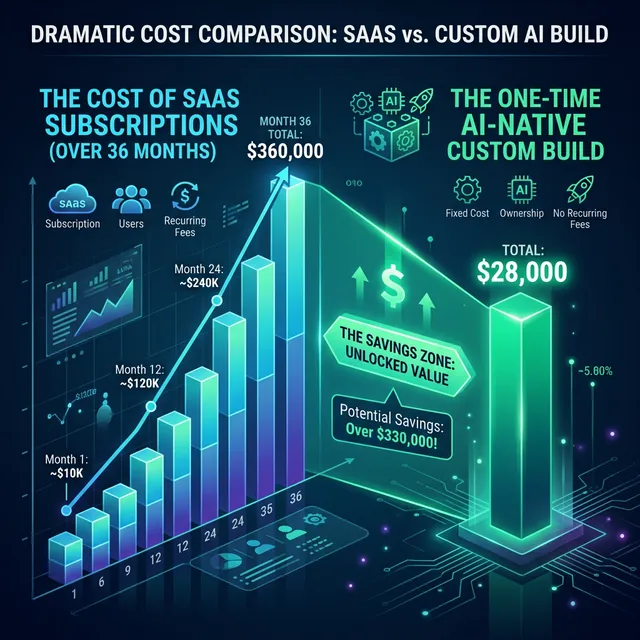
A manufacturing company we worked with replaced a $180,000/year SaaS ERP with a custom AI-Native system built for $28,000. Three years of SaaS fees saved. Their team stopped chasing exceptions - the system catches them automatically.
AI-Native vs. SaaS: A Direct Comparison
| | SaaS Software | AI-Native Custom Software | | ----------------- | ----------------------------------- | ---------------------------- | | Built for | Every company in your industry | Your specific workflows | | AI features | Add-on, often generic | Core, trained on your data | | Data | Vendor's servers, shared | Your infrastructure, private | | Customisation | Limited to settings panel | Unlimited | | Cost | Recurring licence ($500–$10K/month) | One-time build ($5K–$50K) | | Improvement | Vendor's roadmap | Your priorities |
How FastDX Builds AI-Native Software
We use Vibe Coding and Agentic AI methods to build AI-Native systems:
- Week 1: Requirements in plain language → system architecture and working prototype
- Week 2: Core AI integrations, data pipelines, and decision logic
- Week 3: Testing against your real data, refinement, deployment
Typical delivery: 2–4 weeks. Cost: $8,000–$40,000 depending on complexity.
You own 100% of the source code, the database, and the AI model training data. No vendor dependency. No monthly licence.
Is Your Current Software AI-Native?
Ask yourself these questions:
- Does your software act when something happens, or only record it?
- Does your software detect anomalies automatically, or wait for you to spot them?
- Does your software get better with more use, or stay the same?
- Does your software handle variation in inputs, or break when formats change?
If the answer to most of these is "no" or "wait for me to spot it" - you're running software from the last decade. AI-Native software changes all four answers.
The good news: the cost of replacing it has never been lower.