The Direct Answer
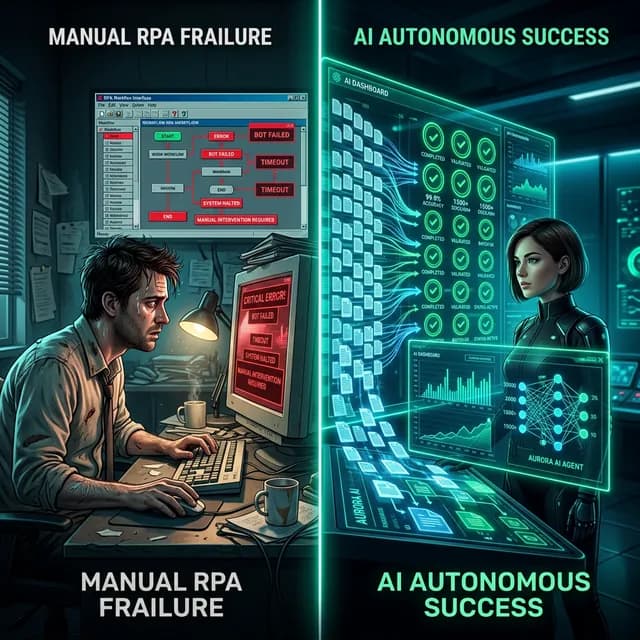
AI-powered development is faster because it automates the slowest parts of software creation: writing boilerplate, debugging, testing, and translating requirements into code. A traditional software project that takes 3 to 6 months can be delivered in 1 to 6 weeks using AI-assisted methods, not by cutting corners, but by eliminating the mechanical work that consumes 60 to 70% of a developer's time in conventional workflows.
The speed gain is not uniform across all tasks. Code generation sees the largest improvement at roughly 10x faster. Testing and test generation run about 5x faster. Debugging accelerates by approximately 3x. Documentation becomes nearly instant. The overall project timeline compresses by 5 to 10x depending on the complexity and type of software being built.
The Traditional Bottleneck
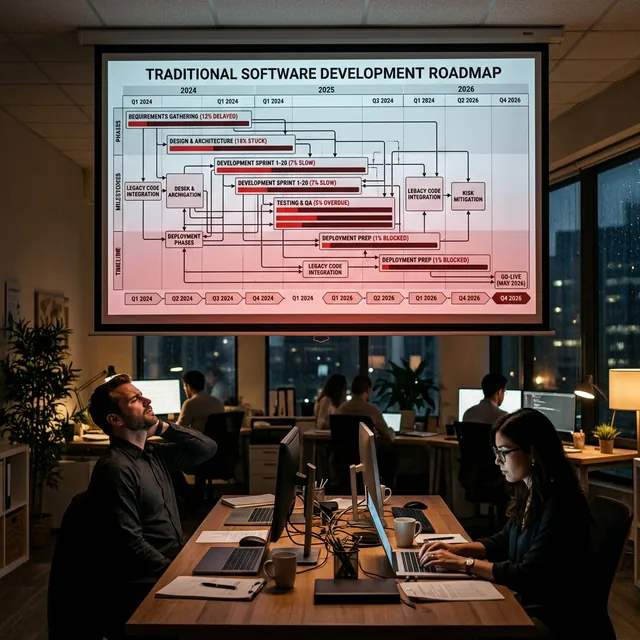
In conventional software development, building a custom business application follows a well-known sequence:
- Requirements gathering (2 to 4 weeks): Meetings, documents, revisions, sign-offs.
- System design (1 to 3 weeks): Architecture decisions, database schema, API contracts.
- Implementation (4 to 12 weeks): Writing code, component by component.
- Testing (2 to 4 weeks): Unit tests, integration tests, user acceptance testing.
- Bug fixing (1 to 3 weeks): Discovering and resolving issues found during testing.
- Deployment and documentation (1 to 2 weeks): Server setup, CI/CD, user guides.

Total: 11 to 28 weeks for a moderately complex business application. The majority of that time is spent on implementation and bug fixing, tasks that involve translating known requirements into syntactically correct code and then finding the mistakes.
This is where AI creates the most impact.
The AI-Powered Flow
With AI-assisted development, the same project follows a compressed sequence:
- Describe the desired outcome in natural language, with specific business rules and acceptance criteria.
- Generate the implementation using AI code generation, producing components, database queries, API endpoints, and frontend interfaces.
- Review the generated code for correctness, security, and alignment with business logic.
- Ship the validated application to production with automated deployment.
The critical difference is not that steps are skipped. Every step still happens. The difference is that the most time-consuming steps (implementation, testing, debugging) are executed by AI in minutes rather than by humans over weeks.
Where the Speedups Come From
| Task | Traditional Time | AI-Powered Time | Speedup | |---|---|---|---| | Code generation (CRUD + validation) | 6–8 hours | 30–45 minutes | ~10x | | Test suite creation | 2 days | Half a day | ~5x | | Bug diagnosis and fix | 2 hours | 40 minutes | ~3x | | Documentation and API reference | 1–2 weeks | Near instant | ~20x |
Code Generation: 10x Faster
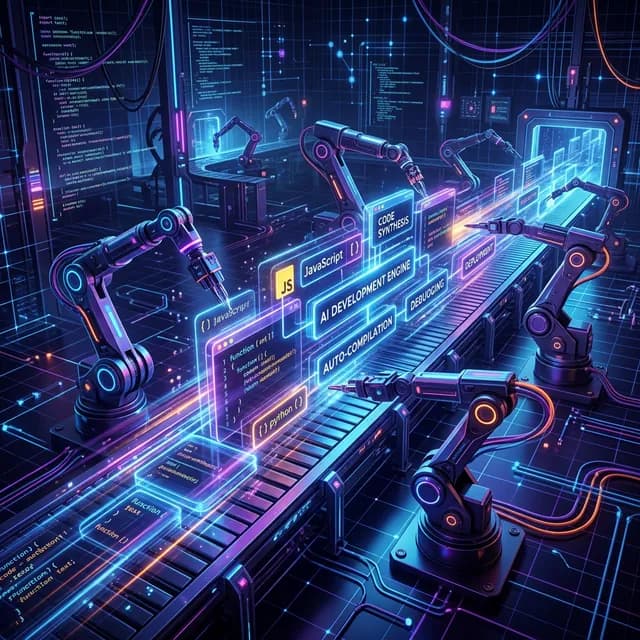
AI models can produce functional code from natural language descriptions at a rate no human can match. A developer writing a CRUD interface with form validation, database operations, error handling, and responsive styling might spend 6 to 8 hours. An AI generates the same output in 30 to 45 minutes, including edge case handling.
The generated code is not perfect. It requires review and refinement. But starting from 85 to 90% complete code and fixing the remaining 10 to 15% is dramatically faster than writing 100% from scratch.
Testing: 5x Faster
Writing tests is one of the most frequently deferred tasks in software projects because it is tedious and time-consuming. AI generates comprehensive test suites, including unit tests, integration tests, and edge case coverage, directly from the application code. A test suite that would take a developer 2 days to write manually can be generated and validated in half a day.
Debugging: 3x Faster
When bugs appear, AI can analyze error messages, trace execution paths, and identify root causes faster than manual debugging. More importantly, AI can examine the entire codebase simultaneously rather than searching file by file. A bug that takes a developer 2 hours to locate and fix can often be resolved in 40 minutes with AI assistance.

Documentation: Near Instant
Technical documentation, API references, inline code comments, and user guides can be generated directly from the codebase. What previously required a dedicated documentation sprint (1 to 2 weeks) now happens as a byproduct of the development process.
The Role of Agentic AI
The latest advancement in AI-powered development is Agentic AI: autonomous AI systems that can handle multi-step tasks without human intervention at each stage. Instead of generating one code file at a time, an agentic system can:
- Read a project specification and break it into implementation tasks.
- Generate the database schema, API layer, and frontend components in sequence.
- Run the test suite, identify failures, and fix them autonomously.
- Refactor code for performance and maintainability.
- Deploy the application and verify it works in the production environment.
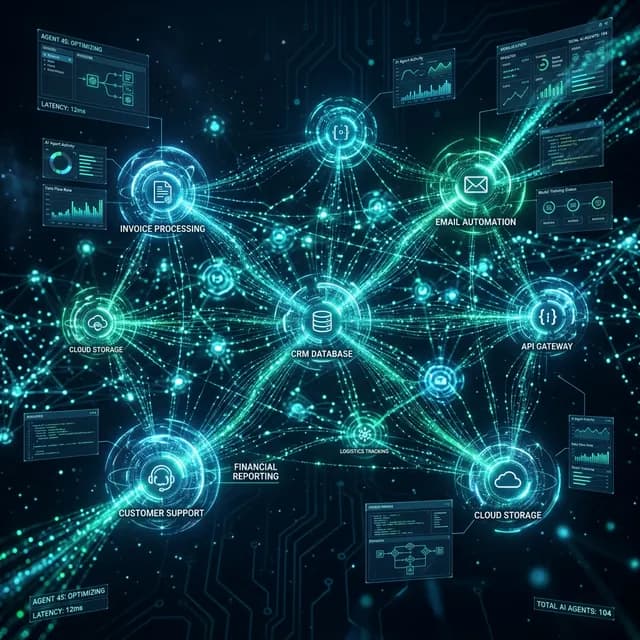
This is the difference between AI as a tool (you prompt it, it responds) and AI as an agent (you give it a goal, it executes the full workflow). Agentic AI handles the orchestration that previously required a project manager, multiple developers, and a QA team.
Quality Assurance: AI Generates, Humans Validate
Speed without quality is not speed. It is rework. The AI-powered development model maintains quality through a clear division of responsibility:

AI handles: boilerplate code, repetitive patterns, test generation, documentation, dependency management, standard security practices, and code formatting.
Humans handle: architecture decisions, business logic validation, security review, user experience evaluation, edge case identification, and final acceptance testing.
This division works because the tasks assigned to AI are precisely the tasks where humans add the least unique value. Writing a database migration, configuring an authentication flow, or building a standard data table are solved problems. The AI has seen thousands of correct implementations and can produce reliable output for these patterns.
The tasks assigned to humans are the tasks where judgment, context, and domain expertise matter. Does this workflow match how the business actually operates? Are there edge cases the specification missed? Is the data model flexible enough for future requirements?
Real Delivery Timelines
At FastDX, these are the timelines we consistently achieve using AI-powered development with human oversight:
| Project Type | Traditional Timeline | AI-Powered Timeline | Compression | Typical Cost | |---|---|---|---|---| | Starter tools (dashboards, internal forms) | 2–4 months | 3–7 days | 5–8x | $3,000–$8,000 | | Business platforms (multi-user, workflows) | 4–8 months | 1–3 weeks | 5–8x | $8,000–$25,000 | | Enterprise systems (complex integrations) | 6–18 months | 3–8 weeks | 5–10x | $25,000–$60,000 |
Traditional equivalents for these projects typically cost $50,000–$150,000+ for business platforms and $200,000–$500,000+ for enterprise systems.
What This Means for Businesses
The practical impact is that custom software is no longer a luxury reserved for companies with large engineering budgets. A mid-size business that previously could not justify a 6-month, $150,000 development project can now get equivalent functionality in 3 weeks for $15,000 to $40,000.
This changes the decision calculus for every business process currently handled by spreadsheets, manual workarounds, or ill-fitting SaaS tools. When building something custom takes days instead of months and costs thousands instead of hundreds of thousands, the question shifts from "Can we afford to build?" to "Can we afford not to?"