Not Just a Chatbot
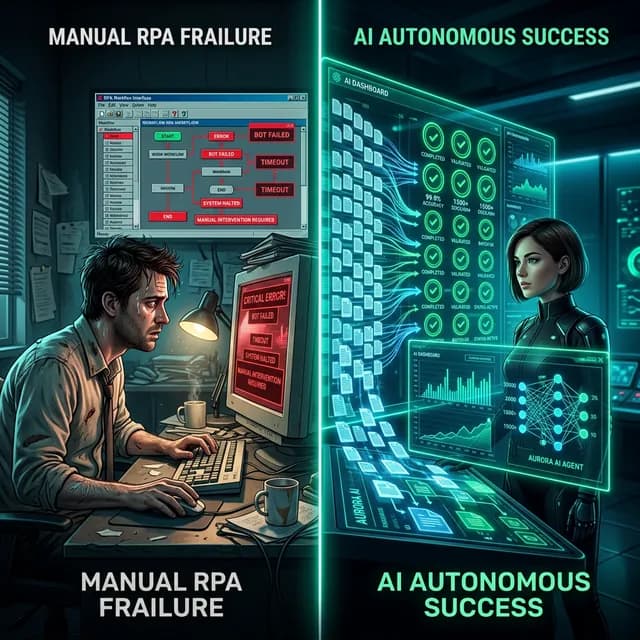
When most people hear "AI agent," they picture a chatbot that answers customer questions. That's a small subset of what agents actually are.
An AI agent is software that can observe its environment, make decisions, and take actions, with minimal human intervention at each step. The key difference from a chatbot: agents do things, not just say things.
What Agents Actually Do
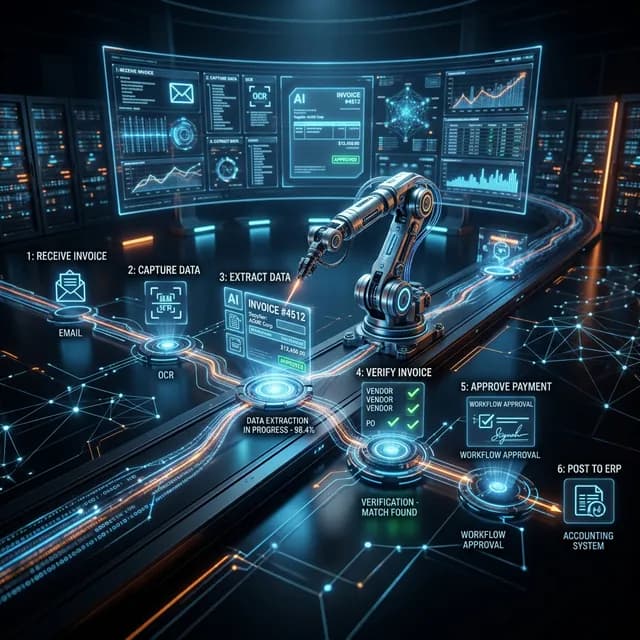
Here's a concrete example. A traditional workflow for processing a supplier invoice:
- Someone receives an email
- Opens the attachment
- Extracts the data manually
- Enters it into the accounting system
- Routes it for approval
- Archives it
An AI agent handles steps 1–6 automatically. It reads the email, understands the invoice (even handwritten or in different formats), extracts the relevant data, creates the record in your system, notifies the right approver, and files the document.
That's not a chatbot. That's a process replacement.
In practice, a finance team processing 200 invoices per month manually spends roughly 8 minutes per invoice on data entry and verification. That's 26 hours of labour per month, or approximately $650–$1,300/month at typical admin salary rates. An AI agent reduces processing time to under 1 minute per invoice with 97%+ extraction accuracy, cutting monthly labour costs by 85–90%.

Three Types of Agents Worth Knowing
1. Document processing agents Extract information from PDFs, emails, images, and forms. Feed it into your systems. Handle contracts, invoices, applications, reports.
2. Decision support agents Analyse data, flag anomalies, summarise situations. An agent that reads your weekly sales data and writes a plain-language summary for your Monday meeting is genuinely useful.
3. Action agents Connect to APIs and take actions: create calendar events, send emails, update records, trigger workflows. These are the most powerful and require the most careful design.
The Business Impact in Numbers
| Agent Type | Manual Cost/Month | With Agent | Annual Savings | |---|---|---|---| | Invoice processing (200/mo) | $1,300 | $150 | $13,800 | | Customer email triage (500/mo) | $2,400 | $300 | $25,200 | | Data entry / CRM updates | $1,800 | $200 | $19,200 | | Weekly report generation | $600 | $50 | $6,600 |
These figures assume a blended labour cost of $25–$40/hour for the manual work being replaced. Most agents pay for themselves within 2–4 months of deployment.
When AI Agents Make Sense
Agents deliver value when:
- A process involves repetitive decisions based on consistent rules
- The task currently requires a human to read, interpret, and act on information
- Volume is high enough that automation pays off (typically 100+ transactions per month)
- Errors are costly but the process currently relies on manual checking (error rates of 2–5% in manual processes drop to under 0.5% with agents)
They're often a bad fit when:
- The decision logic changes frequently and unpredictably
- Errors have severe irreversible consequences and human oversight is genuinely required
- The volume is too low for automation ROI to make sense
The Build-vs-Buy Decision
Off-the-shelf AI tools (Zapier AI, Microsoft Copilot, etc.) handle generic workflows. They work well when your process matches their assumptions.
Custom agents make sense when your process is unique, your data is sensitive, or you need the agent to work within your existing software rather than around it.
At FastDX, we build agents that integrate directly into your existing systems, no new platforms to manage, no data leaving your infrastructure without your control.
What It Takes to Build One
A well-built agent needs:
- Clear task definition (what exactly should it do, and not do)
- Data access (read from where, write to where)
- Error handling (what happens when it's uncertain or wrong)
- Human-in-the-loop checkpoints for high-stakes decisions

The technology exists. The harder part is designing the process correctly before automating it.
Typical Build Timeline and Cost
| Agent Complexity | Build Time | Cost Range | Example | |---|---|---|---| | Simple (single task, one data source) | 3–5 days | $3,000–$8,000 | Invoice data extraction | | Medium (multi-step, 2–3 integrations) | 1–2 weeks | $8,000–$20,000 | Order processing + inventory update | | Complex (decision logic, multiple systems) | 2–4 weeks | $20,000–$45,000 | Full procurement workflow automation |
With AI-powered development, these timelines are 3–5x faster than traditional software builds. A medium-complexity agent that would have taken 2–3 months to develop conventionally now ships in 1–2 weeks.