The Short Answer
Vibe Coding is a software development approach where developers describe what they want in natural language, and AI writes the code. Instead of typing syntax line by line, you explain the outcome you need, an AI model generates the implementation, and a human reviews and refines the result. The term was coined by Andrej Karpathy, former head of AI at Tesla and co-founder of OpenAI, in February 2025.
The core idea is simple: shift the developer's job from writing code to directing code. You focus on what the software should do. The AI focuses on how to make it happen.
How Vibe Coding Works
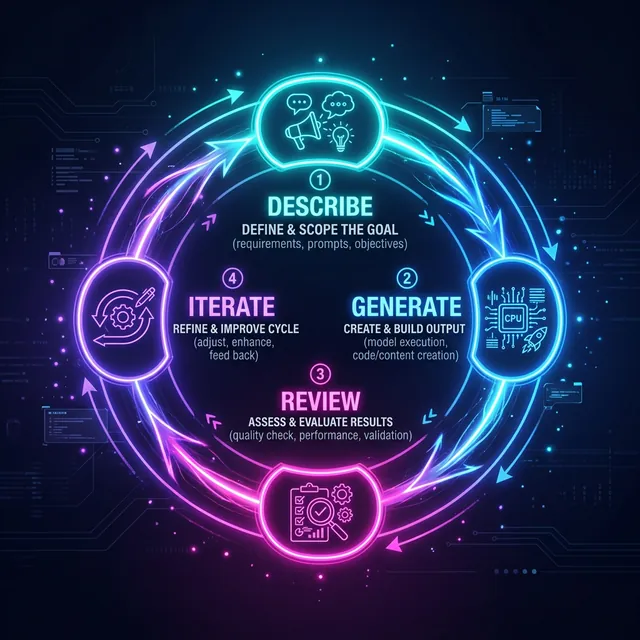
The workflow follows a four-step loop:
- Describe what you want in plain language. For example: "Build a dashboard that pulls sales data from our PostgreSQL database, shows monthly trends in a line chart, and lets users filter by region."
- AI generates the code, including components, database queries, styling, and basic error handling.
- Human reviews the output for correctness, security, and business logic alignment.
- Iterate by giving the AI further instructions: "Add export to CSV," "Make the chart responsive," "Add role-based access."

Each cycle takes minutes, not hours. A feature that might require a full day of traditional development can reach a working prototype in 30 to 60 minutes.
Intent-Driven vs Syntax-Driven Development
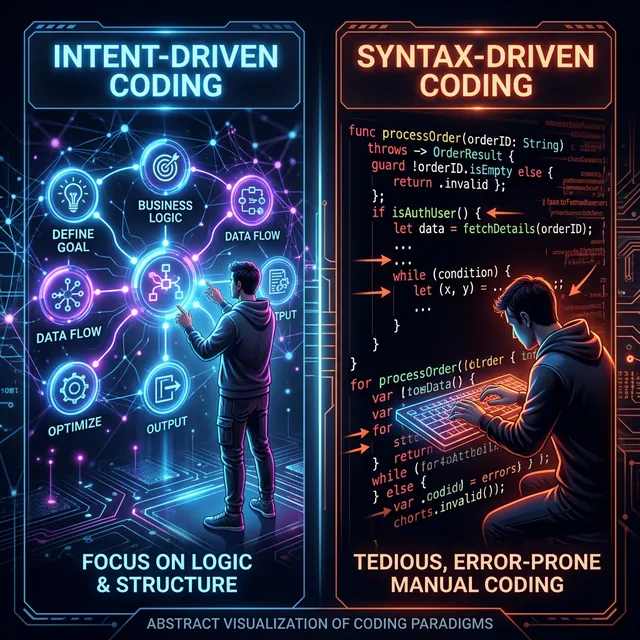
Traditional coding is syntax-driven. Developers spend significant time on boilerplate, configuration files, dependency management, and language-specific patterns. A senior developer might spend 40% of their time on code that adds no unique business value, things like form validation, API routing, authentication flows, and database connection setup.
Vibe Coding is intent-driven. The developer expresses the business requirement, and the AI handles the mechanical translation into working code. This distinction matters because most software projects fail not because of technical complexity, but because of miscommunication between what stakeholders want and what developers build. When the specification is the prompt, the gap between intent and implementation shrinks dramatically.
When Vibe Coding Works Best
Vibe Coding delivers the strongest results in scenarios where speed and iteration matter more than deep algorithmic optimization:
- MVPs and prototypes: Get a working product in front of users in 3 to 7 days instead of 3 to 7 weeks.
- Internal tools: Custom dashboards, reporting interfaces, and admin panels that replace spreadsheet workflows.
- Data transformation: Scripts that clean, merge, and restructure data from multiple sources.
- CRUD applications: Standard business software with forms, tables, search, and role-based access.
- Integration layers: Connecting existing systems that were never designed to talk to each other.
For these use cases, Vibe Coding consistently achieves 80% cost reduction compared to traditional development timelines because the AI eliminates the most time-consuming mechanical work.
| Use Case | Traditional Cost | Vibe Coding Cost | Time Saved | Cost Reduction | |---|---|---|---|---| | MVP / Prototype | $30,000–$80,000 | $3,000–$8,000 | 3–7 weeks → 3–7 days | ~90% | | Internal dashboard | $20,000–$50,000 | $5,000–$10,000 | 2–4 months → 1–2 weeks | 75–80% | | CRUD business app | $40,000–$120,000 | $8,000–$25,000 | 3–6 months → 2–4 weeks | 75–80% | | Integration layer | $15,000–$40,000 | $3,000–$8,000 | 1–3 months → 1–2 weeks | 80% |
When Vibe Coding Falls Short
Not every system should be built this way. Vibe Coding is not the right approach for:
- Safety-critical systems: Medical devices, aviation software, and industrial control systems require formal verification and regulatory compliance that demand line-by-line human accountability.
- High-frequency trading: Microsecond-level performance optimization requires hand-tuned algorithms where every instruction matters.
- Cryptographic implementations: Security-sensitive code where subtle bugs create exploitable vulnerabilities needs deep specialist review beyond what current AI can guarantee.
- Novel research algorithms: When the solution itself is unknown, AI cannot generate what has never been documented.
The common thread: Vibe Coding excels when the problem is well-understood but the implementation is tedious. It struggles when the problem itself requires original invention or carries extreme consequences for subtle errors.
How FastDX Applies Vibe Coding in Production
At FastDX, we combine Vibe Coding with Agentic AI to deliver production-grade custom software, not just prototypes. The difference between a weekend side project and business-critical software is quality assurance, security, scalability, and maintainability.
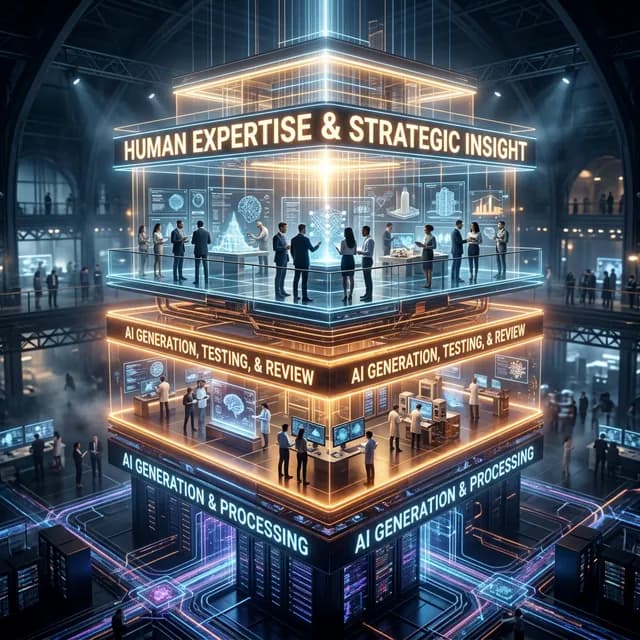
Our process layers human expertise on top of AI generation:
- Architecture decisions are made by experienced engineers who understand scaling patterns, database design, and security requirements.
- AI generates the implementation code, tests, and documentation based on the approved architecture.
- Automated testing validates every generated component against defined acceptance criteria.
- Human review catches business logic errors, edge cases, and security concerns that AI might miss.
This hybrid approach is why we deliver starter tools in 3 to 7 days, business platforms in 1 to 3 weeks, and enterprise systems in 3 to 8 weeks, at a fraction of traditional development cost. The AI handles the volume. The humans handle the judgment.
Real-World Impact
| Project | Traditional Approach | Vibe Coding Approach | Result | |---|---|---|---| | CRM dashboard | 3 months, 3 developers | 2 weeks, 1 engineer + AI | 6x faster, 80% lower cost | | Internal operations tool | $50,000+, 4 months | $5,000, 2 weeks | 10x cost reduction | | Customer portal | 4-person team, 5 months | 1 senior engineer + AI, 3 weeks | 75% fewer resources | | Data reporting suite | $35,000, 2 months | $6,000, 10 days | 83% cost reduction |
Every project includes a clean, well-structured codebase, comprehensive documentation, full test coverage, performance optimization, and security hardening.
The Bigger Picture
Vibe Coding is not a trend or a shortcut. It is a fundamental shift in how software gets built. The developers who adopt it are not replaced by AI. They become more productive, focusing their expertise on the decisions that actually matter: what to build, how it should work for real users, and where the risks are.
For businesses, this means custom software is no longer a six-figure, six-month commitment. The tools your team actually needs can be built in days and refined in real time based on how people actually use them.